
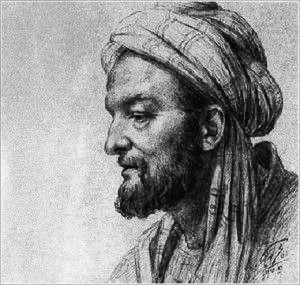
At the age of sixteen, he dedicated all his efforts to learning medicine and by the time he was eighteen gained the status of a reputed physician. His most important contribution to medical science was his famous book Al Qanun Fi Al-Tibb (The Canon of Medicine). This book is an immense five-volume encyclopedia of medicine containing over a million words. It comprises medical knowledge available from ancient and Muslim sources. His other major work is “The Book of Healing”, a scientific and philosophical encyclopedia. This book was intended to ‘heal’ the soul. It was split into four parts: logic, natural sciences, mathematics and metaphysics. In his book, he developed his system of logic, Avicennian logic.
On the existence of God, Ibn Sina published Burhan al-Siddiqin (Proof of the Truthful), in which he laid out an argument for the “necessary existence” or something that can not exist. In astronomy, he proposed that Venus was closer to the Sun than the Earth.
He invented an instrument for observing the coordinates of a star making several astronomical observations and stated that the stars were self-luminous. In mathematics, Avicenna explained the arithmetical concept and application of the “casting out of nines”. Ibn Sina also contributed to poetry, religion and music. In total, Avicenna wrote over 400 works, of which around 240 have survived. The last decade or so of his life, he spent in the service of a military commander Ala al-Dawla Muhammad. He served as a physician and general literary and scientific consultant. )
Sources: https://www.famousscientists.org/avicenna/
https://www.middleeasteye.net/discover/ibn-sina-who-persian-philosopher-physician-and-scientist